Wine Glass Line Art SVG
A Minimalist Silhouette That Stitches Clean—But Only Where It Belongs
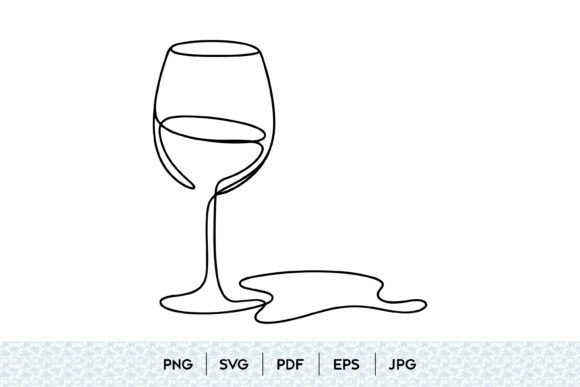
I pulled up Wine Glass Line Art SVG last week while prepping a small-batch run of linen aprons for a local wine-tasting boutique. My goal? A subtle, elegant chest accent—not a loud logo, but something that whispered “craft, care, and celebration.” Right away, the design’s quiet confidence stood out: one continuous line, no fills, no shading, just a graceful curve of stem, bowl, and rim. It’s not playful or cartoonish—it’s refined, slightly architectural, and unmistakably adult. That mood matters. This isn’t a design for toddler onesies or glitter-embroidered festival totes. It’s for the customer who chooses ceramic over plastic, linen over polyester, and understatement over shout.
Where It Shines in Real Embroidery Projects
In practice, Wine Glass Line Art SVG works best as a running stitch or fine satin stitch outline—especially on stable, medium-weight fabrics like cotton twill, brushed poly-cotton, or midweight linen. I tested it on a natural-color canvas tote bag first: hooped with tear-away stabilizer, stitched in matte black 40-weight thread. The result was crisp, legible at 3.2 inches wide, and held up beautifully after two washes. No puckering. No broken lines.
It’s also ideal for sweatshirt embroidery—placed just above the left pocket—where its clean geometry balances the fabric’s texture without competing. On baby embroidery? Use caution: while lovely on a neutral muslin swaddle, avoid it on stretchy bamboo blends unless you add light cutaway stabilizer and reduce stitch speed. The single-line nature means any distortion shows instantly.
For embroidered patches, this design translates well into a clean, sew-on motif—especially when backed with iron-on fusible web. And for Etsy sellers listing printable mockups or digital embroidery files, Wine Glass Line Art SVG pairs naturally with minimalist branding: think “vineyard wedding favors,” “sommelier gift sets,” or “small-batch olive oil labels.” Its elegance lifts perceived value without demanding premium pricing.
Where It Needs Thoughtful Handling
This is not a forgiving design for tight curves or unstable surfaces. On caps or curved visors, the stem tends to compress or distort unless digitized with strategic pull compensation—a step most free or low-cost converters skip. If you’re using an auto-digitized version (or converting the SVG yourself), inspect the junction where the base meets the stem. That tiny angle can easily become a stitch cluster or gap if not smoothed manually.
Dark fabrics demand contrast testing: what reads as delicate on ivory linen may vanish on navy fleece without a white underlay or a slightly thicker thread weight. Likewise, textured fabrics—like terry cloth tea towels or bouclé pillow covers—will mute fine line work. In those cases, consider adding a 0.5mm outline stitch or switching to a bold satin border instead of pure running stitch.
And don’t assume it scales down gracefully. Below 2 inches wide, the bowl loses definition; below 1.5 inches, the entire shape risks looking like a squiggle. For baby embroidery or tiny pocket accents, stick to the 2.0–2.8 inch range—and always test on scrap first.
What It Says About Your Handmade Product—Before a Single Stitch
Customers notice intention. When someone sees Wine Glass Line Art SVG on a kitchen towel or a personalized cork coaster, they read craft, restraint, and attention to detail—not mass production. That impression builds trust, especially for small shop owners and Etsy sellers whose buyers choose handmade precisely to avoid generic clip art.
But that same elegance becomes a liability if mismatched. Slapping it onto a neon-pink trucker hat? It’ll feel disconnected—not curated. Pairing it with overly ornate fonts or busy patterns in your listing mockups dilutes its strength. Let it breathe. Use generous white space. Match thread colors to your brand palette—not just what’s in your thread box.
For commercial embroidery, remember: the simplicity of Wine Glass Line Art SVG makes it highly adaptable across product types—tote bags, aprons, napkins, even monogrammed wine sleeves—but only if applied with consistency. One version on your website, another on your packaging, and a third on your social banners confuses brand recognition. Choose *one* optimized size and stitch style, then replicate it.
Practical Designer Notes Before You Stitch
- Always test on scrap fabric—same type, same stabilizer, same thread count you’ll use on the final piece.
- Check thread color contrast on both light and dark backgrounds before digitizing or ordering pre-digitized files.
- Review stitch density: minimal line art should run between 10–12 stitches per mm. Too dense = stiffness; too sparse = fragility.
- Confirm hoop size compatibility. At standard scaling, this fits comfortably in a 4x4 hoop—but verify before loading.
- Inspect corners and endpoints. Continuous line drawings often have start/stop points that need trimming or overlapping in embroidery software.
- Test black-and-white mockups first. If it doesn’t read clearly without color, it won’t stitch clearly either.
- Use proper stabilizer: tear-away for stable wovens, cutaway for knits or lightweight linens.
- Verify licensing before selling finished products or bundling the file with other digital embroidery files—especially if reselling as part of a craft business kit.
Final Thought: Less Is Anchored—Not Empty
Wine Glass Line Art SVG isn’t “just a wine glass.” It’s a visual pause. A nod to ritual. A quiet signature that works because it doesn’t try to do everything. Used well—in the right fabric, at the right scale, with thoughtful thread and stabilizer choices—it elevates a simple tote bag into a keepsake, a plain sweatshirt into a conversation starter, and a small shop’s product line into something cohesive and intentional. But like any strong minimalist design, its power lies entirely in context. Respect the line. Honor the space around it. And stitch it where it belongs—not everywhere it fits.