Lace Border Clipart Collection
First Impression: Delicate, Versatile, and Quietly Confident
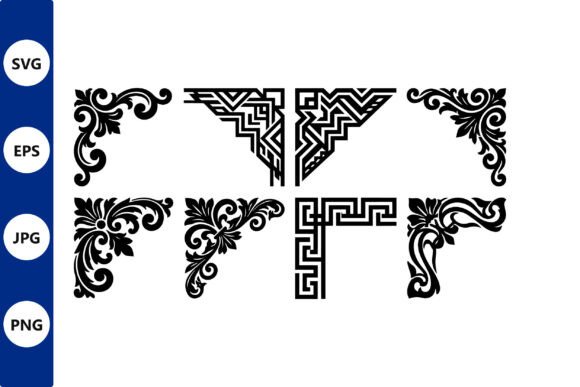
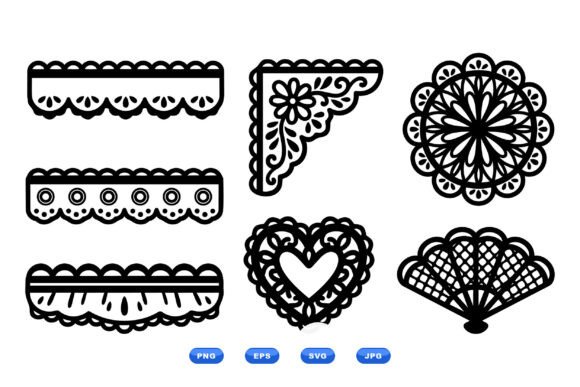
Opening the Lace Border Clipart Collection, I didn’t see “clipart” — I saw a set of hand-edited line art motifs that breathe elegance without shouting. The trims, doilies, heart fans, and corner ornaments aren’t fussy or over-rendered; they’re clean, balanced, and intentionally restrained. That’s rare. As someone who’s stitched hundreds of lace-inspired designs onto baby onesies, boutique tea towels, and custom aprons, I immediately sensed this collection would translate well to embroidery — not as literal lace replication (which rarely stitches cleanly), but as *lace language*: rhythm, repetition, open space, and graceful interruption.
Real-World Test: A Linen Tote Bag for a Local Bakery
Last week, I used three elements from the Lace Border Clipart Collection to frame a monogram on a natural linen tote bag for a small-batch bakery client. I chose a subtle corner ornament + a narrow border strip along the bottom hem — no fill-heavy sections, just crisp outlines and airy loops. On the machine, it stitched cleanly with a 40-weight cotton thread and medium tear-away stabilizer. No puckering. No skipped stitches. What stood out wasn’t just technical performance — it was how the design elevated the whole piece. Customers noticed the detail. They paused. They asked, “Is that hand-drawn?” That quiet sophistication is exactly what handmade product buyers pay for — and what makes a small shop item feel intentional, not mass-produced.
Where It Shines (and Where to Pause)
The Lace Border Clipart Collection excels in projects where subtlety supports story — not overshadows it. Think:
- Embroidered patches for denim jackets or backpacks: the clean line work reads clearly at 2–3 inches wide;
- Baby embroidery on organic cotton burp cloths or knit caps: delicate motifs read as soft, not sharp;
- Holiday embroidery on velvet pillow covers or wool-blend stockings: the open shapes let fabric texture show through;
- Custom apparel like sweatshirt hems or sleeve cuffs: a single repeating fan motif adds polish without bulk;
- Printable mockups for Etsy sellers: vector clarity means crisp digital previews at any size.
But — and this matters — avoid forcing it into roles it wasn’t built for. Don’t use the densest doily element as a full-fill satin stitch background on a stretchy t-shirt. Don’t scale the smallest corner ornament down to 0.5" for a toddler’s cap brim without testing first. And don’t assume it’ll hold up on thin silk charmeuse without extra stabilizer or adjusted stitch density. This is line art, not engineered embroidery file — so treat it as raw design assets, not plug-and-play machine embroidery design.
Stitching Realities: Texture, Contrast, and Trust
What makes or breaks lace-style embroidery isn’t just the design — it’s how it behaves on real fabric. With the Lace Border Clipart Collection, contrast is your friend. I tested one heart fan motif on both charcoal twill and ivory linen: on dark fabric, a cream thread gave warmth and visibility; on light fabric, navy thread added quiet authority. Neither looked flat. Both felt considered. That flexibility builds customer trust — especially for Etsy sellers offering personalized gifts. When buyers see consistent, refined detail across listings (a matching border on a baby blanket + coordinating napkin set), they sense professionalism, not hobbyism.
Fabric texture matters too. On nubby bouclé or thick terry cloth, I simplified the motif — skipping the finest inner loops — and increased stitch length slightly. On smooth piqué or poplin, every curve held. That adaptability is why this collection fits so many craft business needs: you’re not locked into one look. You’re given vocabulary — and room to edit.
Practical Designer Notes Before You Stitch
Before using the Lace Border Clipart Collection in any finished product — whether for sale or gifting — here’s what I do every time:
- Test on scrap fabric — same type, same wash/dry cycle as the final item;
- Check thread color contrast in natural light *and* under store lighting (many boutique buyers photograph in daylight);
- Review stitch density — if converting to embroidery file yourself, avoid overloading fine lines with dense fill stitches;
- Confirm hoop size compatibility — some corner ornaments span wider than standard 4×4 hoops;
- Inspect small details at actual stitch scale — those tiny heart loops may vanish if scaled below 1.25";
- Test black-and-white mockups — ensures legibility for branding or monogram pairing;
- Compare light vs. dark backgrounds — not just for stitching, but for digital product previews;
- Use appropriate stabilizer — lightweight cutaway for knits, tear-away for stable wovens;
- Verify licensing — since this is an Illustrations/Graphics download, confirm commercial use rights before selling embroidered goods or reselling as digital embroidery file.
Final Thought: Not Just Decoration — Design Intention
The Lace Border Clipart Collection doesn’t scream “look at me.” It whispers “this was chosen.” That’s invaluable when you’re building a craft business, curating holiday embroidery for a local maker fair, or designing a signature line of embroidered kitchen towels. It gives you structure without rigidity, elegance without fragility, and versatility without vagueness. For small shop owners, Etsy sellers, and designers who care how their handmade product feels in someone’s hands — not just how it looks online — this is more than graphics. It’s thoughtful design infrastructure.